
AEO for local businesses is the practice of structuring your entity signals, content, and trust infrastructure so that AI systems — Google AI Overviews, ChatGPT, Perplexity, and others — can clearly understand, verify, and cite your business when users ask questions you should be answering. It is not a replacement for local SEO. It is the structural layer that determines whether AI selects you as the answer.
Most local businesses think AI visibility is a future problem.
It is not. AI Overviews now appear in the majority of local searches. ChatGPT and Perplexity are already being used to find local service providers. And the businesses getting cited right now are not necessarily the best businesses in their markets — they are the most structurally legible ones.
The problem is not what you are doing wrong. It is what AI cannot read clearly about you.
There is a gap between how a business presents itself online and how an AI system is able to interpret that presentation. Most local businesses have never been built to be understood by a machine that reads, not clicks. That gap — the legibility gap — is fixable. But it requires understanding what AI systems actually need from you, which is different from what search engines have needed for the past 20 years.
This guide explains what AEO means for local businesses, how it differs from local SEO, and exactly how to build the signal stack that makes AI systems confident enough to cite and recommend you.
What AEO Means for Local Businesses
Answer Engine Optimization is the practice of structuring your content, entity signals, and trust infrastructure so that AI systems can extract answers from your business and present them to users. For local businesses, this means making sure AI can confidently answer five questions about you:
What do you do? Not in marketing language — in plain, specific terms. "We repair HVAC systems for residential and commercial properties in the Austin metro area" is useful to an AI. "We provide exceptional comfort solutions for your home and business" is not.
Where do you operate? AI systems need to know your service area, your physical location (if applicable), and the specific cities and regions you serve. Vague service area descriptions create uncertainty. Specific geographic associations create confidence.
Who do you serve? Residential or commercial? Homeowners or property managers? Individual consumers or businesses? The more clearly you define your customer, the easier it is for AI to match you to the right query.
Why are you credible? Reviews, citations, third-party mentions, years in business, licensing and certifications — these are the evidence signals AI systems use to assess whether a business is trustworthy enough to recommend.
When should you be recommended? This is about query matching. If someone asks "who fixes HVAC in Cedar Park?" — are you the obvious answer? That depends on whether your content, schema, and entity signals are aligned with that query.
AEO for local businesses is the work of making all five of these answers clear, consistent, and machine-readable across every surface where AI systems look for information.
Local SEO vs Local AEO — What's Actually Different
Local SEO and local AEO share most of the same infrastructure. The difference is in how you think about what you are building and why.
| Area | Local SEO Focus | Local AEO Focus | Why It Matters |
|---|---|---|---|
| Primary goal | Rank in Google local pack | Be cited and selected by AI systems | Different targets require different optimization priorities |
| Success metric | Rankings, clicks, impressions | AI citations, AI Overview appearances, brand mentions in AI responses | You can rank #1 and still be invisible in AI |
| Content strategy | Keywords, volume, backlinks | Answer-first structure, entity clarity, topical depth | AI extracts answers, it does not click links |
| Google Business Profile | Citations, reviews, categories | Entity verification, service clarity, review evidence | GBP is a primary AI entity verification signal |
| Schema markup | Nice to have | Core infrastructure | AI systems rely on schema to understand business type and services |
| Reviews | Social proof for humans | Evidence base for AI systems | AI reads review content, not just star ratings |
| Local citations | NAP consistency for rankings | Entity verification signals for AI | Consistency across sources reduces AI uncertainty |
| Content format | Keyword-optimized pages | Answer-first, extractable, definitionally clear pages | AI needs to extract answers, not rank pages |
| Timeline | 3–6 months to ranking | Ongoing structural build; some signals take effect quickly | AEO is infrastructure, not a campaign |
The key insight is that local SEO optimizes for ranking. Local AEO optimizes for selection. These are related but distinct outcomes. A business can rank well and still not be selected by AI if its entity signals are unclear, its content is not structured for extraction, or its trust signals are inconsistent.
Why Ranking Locally Is Not the Same as Being Selected by AI
Search engines rank pages. AI systems select answers.
When a user searches Google for "HVAC repair near me," the search engine returns a list of pages ranked by relevance and authority. The user chooses which result to click. The business wins by ranking high enough to get the click.
When a user asks ChatGPT or Google AI Overview "who does HVAC repair in Cedar Park?" — the AI system does not return a list of pages. It selects a business (or a small set of businesses) and presents them as the answer. The user does not click through to evaluate options. They act on the AI's recommendation.
This is a fundamentally different dynamic. And it rewards a fundamentally different kind of optimization.
AI systems do not reward quality — they reward clarity. A well-structured, clearly-defined business with moderate authority will outperform a high-authority business with unclear entity signals in AI-generated responses. This is counterintuitive if you are used to thinking about SEO in terms of domain authority and backlinks. But it makes sense when you understand how AI systems work: they are pattern-matching systems that need to be confident before they cite a source. Ambiguity reduces confidence. Clarity increases it.
The businesses that are getting cited in AI Overviews and AI chatbot responses right now are not necessarily the biggest or the best in their markets. They are the ones whose entity signals are clear, whose content is structured for extraction, and whose trust signals are consistent across sources. That is a structural advantage — and it is available to any business willing to build it.
How AI Systems Understand Local Businesses
AI systems use four layers of signals to understand and evaluate a local business. Understanding these layers is the foundation of local AEO.
Layer 1: Entity Recognition. Does AI know this business exists as a distinct, named entity? Entity recognition is about consistency. If your business name appears differently across your website, Google Business Profile, schema markup, and third-party citations — "Smith's Plumbing" vs "Smith Plumbing LLC" vs "Smith Plumbing & Drain" — AI systems register these as potentially different entities. Inconsistency creates ambiguity. Ambiguity reduces citation confidence.
Layer 2: Service and Location Clarity. Does AI know exactly what the business does and where it operates? This is about specificity. "We offer plumbing services" is less useful to an AI than "We provide residential and commercial plumbing repair, installation, and drain cleaning in Cedar Park, Round Rock, and Georgetown, TX." Named services with descriptions, service area definitions, and city/location associations all contribute to service and location clarity.
Layer 3: Trust and Credibility Signals. Does AI have evidence that this business is real, active, and trustworthy? Reviews, citations, third-party mentions, GBP verification, years in business, licensing information, and press mentions all contribute to the trust signal stack. AI systems use these signals to assess whether a business is credible enough to recommend. A business with thin or inconsistent trust signals will be passed over in favor of one with a richer evidence base — even if the thin-signal business is objectively better.
Layer 4: Answer Extraction. Can AI pull a direct, useful answer from the business's content when a user asks a relevant question? This is about content architecture. Answer-first structure, FAQ blocks, schema markup, and clear headings all enable AI systems to extract answers from your content. A page that buries the answer in paragraph three of a 500-word marketing description is not extractable. A page that opens with a direct answer and structures supporting information around it is.
The Local AI Visibility Stack
Every local business that wants to be cited by AI needs to build the same foundational infrastructure. The Local AI Visibility Stack is a nine-layer framework that organizes this infrastructure from the ground up.
The stack is sequential. Each layer builds on the one below it. You cannot skip layers and expect consistent results.
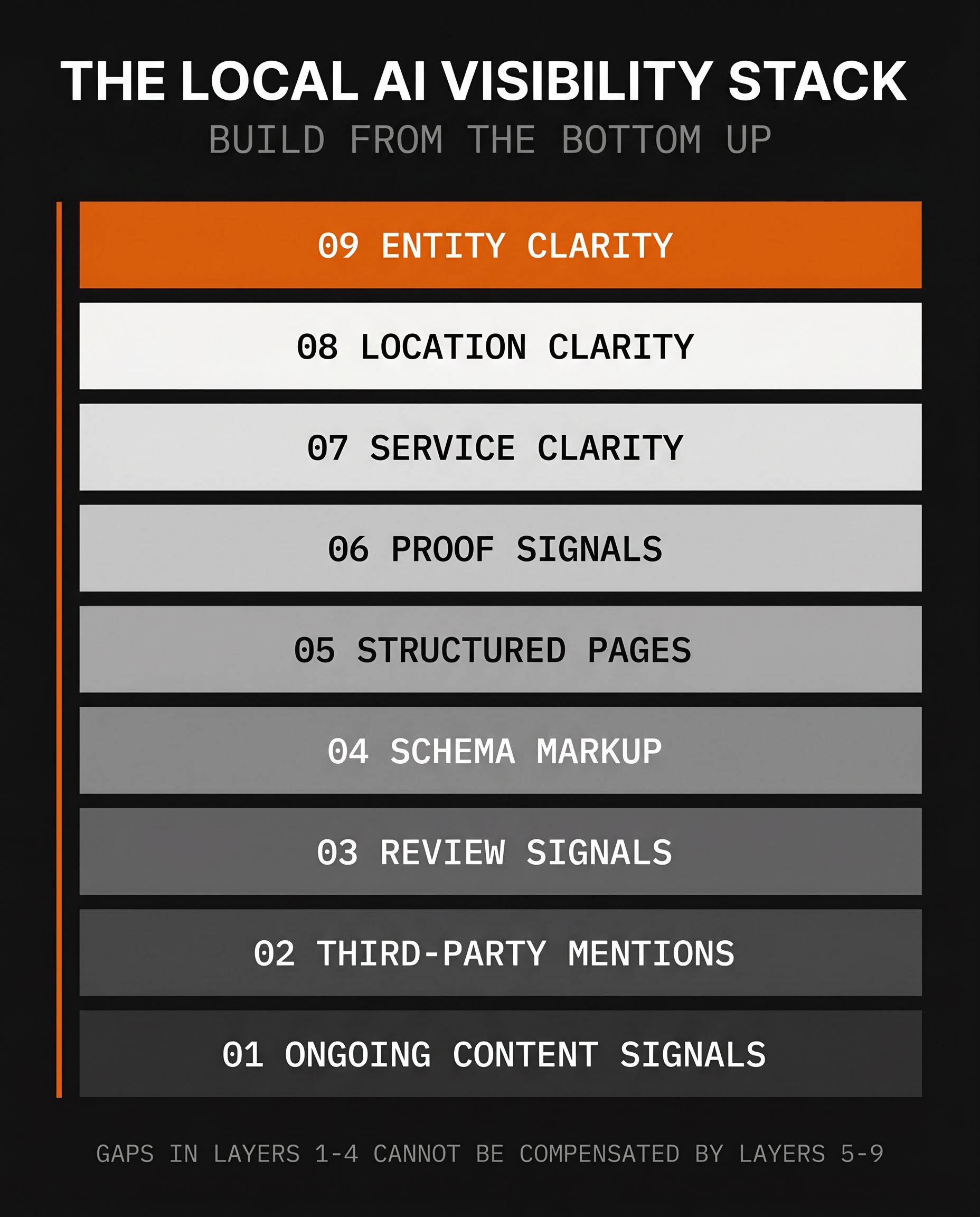
Layer 1 — Entity Clarity: AI knows who you are. Your business name, type, location, and key person are consistent across all sources. This is the foundation. Everything else depends on it.
Layer 2 — Location Clarity: AI knows where you operate. Your service area, physical address (if applicable), and city/region associations are explicit and consistent. Vague location signals create geographic ambiguity that reduces local citation likelihood.
Layer 3 — Service Clarity: AI knows what you do. Your services are named, described, and associated with specific locations. Not marketing descriptions — operational descriptions. What service, for whom, in what area.
Layer 4 — Proof Signals: AI has evidence you are real and trustworthy. Google Business Profile is verified and complete. Reviews exist and are recent. Basic citations are consistent. This layer is the minimum viable trust threshold.
Layer 5 — Structured Pages: AI can extract answers from your content. Service pages and location pages are built with answer-first architecture. Headings are question-based or answer-first. Content is organized for extraction, not just for reading.
Layer 6 — Schema Markup: AI has machine-readable confirmation of your entity and services. LocalBusiness JSON-LD is implemented. Service schema is on service pages. FAQPage schema is on FAQ blocks. Schema does not guarantee citation — it removes ambiguity.
Layer 7 — Review Signals: AI has a rich evidence base from customer reviews. Reviews mention specific services, specific locations, and specific outcomes. Review volume is sufficient to establish credibility. Review recency signals active business.
Layer 8 — Third-Party Mentions: AI can verify your existence and credibility from external sources. Industry directories, local press, community mentions, and social platform presence all contribute to third-party verification.
Layer 9 — Ongoing Content Signals: AI sees active, current content production. GBP posts, blog updates, new reviews, and social mentions signal that the business is active and current. Stale signals reduce citation confidence over time.
Most local businesses have gaps in layers 1–4 before they even get to content or schema. The AI visibility audit always starts at the bottom of the stack.
Google Business Profile Optimization for AI Visibility
Google Business Profile is not just a citation source. For AI visibility, it is a primary entity verification signal.
Google's AI systems use GBP data to verify that a business is real, active, categorized correctly, and trustworthy. An incomplete, inconsistent, or unverified GBP is not just a missed opportunity — it is an active liability for AI visibility because it creates conflicting entity signals.
Business name: Must be identical to your website, schema markup, and all citations. No variations, no keyword stuffing, no location modifiers. Exact match only.
Primary category: Be specific. "HVAC Contractor" not "Contractor." "Family Law Attorney" not "Lawyer." The primary category is one of the strongest signals AI uses to understand what type of business you are. Generic categories create ambiguity.
Secondary categories: Add all relevant secondary categories. A plumbing company might add "Drain Cleaning Service," "Water Heater Installation Service," and "Emergency Plumber." Each secondary category expands the query surface AI associates with your business.
Business description: Write this to answer "what does this business do?" — not to sell. Include your primary service, your service area, and one or two differentiating facts. Keep it under 750 characters. AI systems read this as a primary entity description.
Services section: Fill this out completely. Name every service you offer. Add descriptions. This is a direct input to AI's understanding of your service clarity. Most businesses leave this section sparse or empty.
Q&A section: Seed this with your own questions and answers. This is a direct FAQ surface that AI systems read. Most businesses ignore it entirely — or worse, let competitors or random users seed it with inaccurate information. Own this section.
Photos: Add recent photos that show real work. Label them accurately. Photos signal active business and contribute to entity credibility.
GBP posts: Publish at least monthly. Posts signal active business and provide fresh content signals. They do not need to be elaborate — a brief update about a recent job, a seasonal service reminder, or a quick tip is sufficient.
Service Pages and City Pages — Structure for AI Extraction
Service pages and location pages are the primary content surfaces where AI systems look for answers about what a local business does and where it operates. Most local business service pages are written as marketing copy. They describe how great the business is. They do not answer the questions AI is trying to answer on behalf of users.
An answer-first service page structure looks like this:
The H1 directly names the service and location: "HVAC Repair in Cedar Park, TX." The opening paragraph directly answers "What is HVAC repair and who provides it in Cedar Park?" — in plain, specific language. The body covers the service in operational terms: what it includes, what the process looks like, what the outcomes are, what the service area covers. A FAQ block with FAQPage schema answers the five to ten questions customers most commonly ask about this service. LocalBusiness and Service schema confirms the entity and service in machine-readable format.
For businesses that serve multiple cities or operate across a service area, location pages follow the same principle — but with unique, locally-specific content for each city. Templated city pages that swap out the city name and nothing else do not provide the content depth AI needs to extract useful, location-specific answers. Each city page should include local references, local customer signals, and city-specific FAQ content.
The test for any service or location page is simple: if an AI system reads only this page, can it confidently answer "what does this business do, where do they do it, and why should I trust them?" If the answer is no, the page needs to be restructured.
Reviews and Testimonials as AI Trust Signals
Most local businesses treat reviews as social proof for humans. For AI visibility, reviews are an evidence base.
AI systems read review content — not just star ratings — to understand what a business does, where it operates, and whether it is trustworthy. A business with 200 reviews that mention specific services, specific locations, and specific outcomes is giving AI a rich evidence base to work from. A business with 12 generic five-star reviews that say "great service!" is providing almost no useful entity signal.
This changes how you should think about review generation. The goal is not just volume — it is content quality. When asking customers for reviews, give them a gentle prompt: "If you have a moment to leave a review, it helps if you mention the specific service you had done and the city you're in." Most customers are happy to do this if asked. The result is reviews that say "Alex fixed our AC unit in Cedar Park on a 100-degree day and had it running within two hours" — which is far more valuable to AI than "5 stars, highly recommend."
Review platform diversity also matters. Google reviews are the primary signal, but reviews on Yelp, industry-specific platforms (Angi, HomeAdvisor, Houzz), and the Better Business Bureau contribute to the third-party verification layer. AI systems cross-reference across platforms to assess credibility. A business with strong reviews only on Google is less verified than one with consistent reviews across multiple platforms.
Respond to every review — positive and negative. Owner responses signal engagement, legitimacy, and active business management. They also provide additional content that AI systems can read.
LocalBusiness Schema and Structured Data
Almost no local businesses have correct schema markup implemented. Most have none. Some have auto-generated schema from their website platform that is incomplete, generic, or wrong. This is the single fastest structural fix available — and it is an immediate competitive advantage because almost no one has done it.
Schema markup is the machine-readable layer that tells AI systems exactly what your business is, what it does, where it operates, and how to verify it. It does not guarantee AI citation. What it does is remove ambiguity — and ambiguity is the primary reason AI systems skip businesses they could otherwise cite.
The minimum viable LocalBusiness schema for a local business looks like this:
{
  "@context": "https://schema.org",
  "@type": "Plumber",
  "name": "Smith Plumbing LLC",
  "description": "Residential and commercial plumbing repair, installation, and drain cleaning in Cedar Park, Round Rock, and Georgetown, TX.",
  "url": "https://smithplumbing.com",
  "telephone": "+15125550100",
  "address": {
    "@type": "PostalAddress",
    "streetAddress": "123 Main Street",
    "addressLocality": "Cedar Park",
    "addressRegion": "TX",
    "postalCode": "78613",
    "addressCountry": "US"
  },
  "geo": {
    "@type": "GeoCoordinates",
    "latitude": 30.5052,
    "longitude": -97.8203
  },
  "openingHours": "Mo-Fr 08:00-18:00",
  "sameAs": [
    "https://www.google.com/maps/place/smith-plumbing-llc",
    "https://www.linkedin.com/company/smith-plumbing-llc",
    "https://www.yelp.com/biz/smith-plumbing-llc"
  ]
}
Use the most specific `@type` available for your business category. Schema.org has subtypes for hundreds of business categories — "Plumber," "HVACBusiness," "DentalClinic," "LegalService," and many more. The more specific the type, the clearer the entity signal.
Add Service schema on service pages to name and describe each service. Add FAQPage schema on every FAQ block. Add Person schema for the business owner or key team member. Each layer of schema reduces ambiguity and increases AI citation confidence.
Local FAQs and Answer-First Content
FAQ sections are one of the highest-value AEO investments for local businesses. They directly answer the questions AI systems are trying to answer on behalf of users. A well-structured FAQ block with FAQPage schema is both a Featured Snippet target and an AI Overview source.
The best local business FAQs are not written from keyword research. They are written from the questions customers actually ask. What do people call before booking? What do they ask during the job? What do they wonder about but never ask? Those are your FAQ questions.
For local businesses, FAQs should include three categories of questions. Service questions answer what the service includes, how long it takes, what it costs, and what the process looks like. Location questions answer what cities you serve, whether you travel to specific areas, and what your service radius is. Trust questions answer how long you have been in business, whether you are licensed and insured, what your guarantee or warranty is, and what happens if something goes wrong.
Write answers in 50–100 words — direct, complete, and extractable. Do not hedge. Do not use marketing language. Answer the question as if you are talking to a customer who needs a straight answer.
Implement FAQPage schema on every FAQ block. This is the technical layer that tells AI systems "this section contains questions and answers that are directly relevant to user queries." Without the schema, AI systems may still read the content — but the schema makes the signal explicit and machine-readable.
Third-Party Local Citations and Directory Consistency
Third-party citations serve two functions in local AEO. They verify that a business exists (entity verification), and they provide consistent signals about the business's name, address, phone, and category (NAP consistency). AI systems use citation data to cross-reference and verify entity information. Inconsistencies across citations create entity ambiguity. Consistency across citations builds entity confidence.
The citation priority list for local businesses starts with the platforms AI systems trust most: Google Business Profile, Apple Maps, Yelp, and Bing Places. These are tier-one verification sources. From there, industry-specific directories matter more than generic directories — a plumber on Angi and HomeAdvisor is more credibly verified than a plumber on 50 generic business listing sites. Local sources — the chamber of commerce, local news sites, local blogs, and neighborhood platforms — contribute local entity signals that generic directories cannot.
Data aggregators (Data Axle, Neustar Localeze, Foursquare) distribute business information to hundreds of downstream directories. Correcting your data at the aggregator level is more efficient than chasing individual directory listings.
Citation quality matters more than citation quantity. A consistent, complete citation on 20 authoritative sources is worth more than 200 inconsistent citations on low-quality directories. Audit your existing citations before building new ones — inconsistencies in existing citations are more damaging than the absence of new ones.
YouTube, LinkedIn, Reddit, and Community Mentions as Local Signals
AI systems do not only read websites. They read the broader web — social platforms, video content, forums, and community discussions. For local businesses, mentions in these channels serve as third-party entity verification signals that reinforce and extend the core signal stack.
A local business owner with a YouTube channel that mentions the business name, location, and services in video titles, descriptions, and transcripts is building AI-readable entity signals. Even a handful of videos can contribute. The content does not need to be elaborate — a walkthrough of a recent job, an answer to a common customer question, or a brief introduction to the business and service area is sufficient.
LinkedIn is heavily indexed and trusted by AI systems. A business owner's LinkedIn profile that clearly associates them with their business, location, and services contributes to entity clarity. A company LinkedIn page with consistent name, description, and service information adds another verification layer. These are low-effort, high-value signals.
Reddit is organic — you cannot manufacture it — but you can earn it. Local subreddits (r/Austin, r/CedarPark, r/RoundRock) and industry subreddits where the business is genuinely mentioned or recommended are strong third-party signals. The way to earn Reddit mentions is to be genuinely helpful in relevant communities. Answer questions. Provide real information. Do not pitch. Over time, this builds the kind of organic mention that AI systems treat as credible third-party evidence.
Community mentions — local news coverage, neighborhood Facebook groups, Nextdoor recommendations, and local blog features — all contribute to the entity verification signal stack. These are not replacements for the core signal stack. They are amplifiers. Build the foundation first, then look for opportunities to earn mentions in these channels.
Common Local AEO Mistakes
Most local businesses are not invisible to AI because they are doing something wrong. They are invisible because they have never built the structural foundation that AI needs to cite them confidently. These are the most common gaps.
Inconsistent business name across sources. Even minor variations — "Smith Plumbing" vs "Smith Plumbing LLC" vs "Smith's Plumbing" — create entity ambiguity. AI systems may register these as different entities. Use the exact same business name everywhere, every time.
GBP categories that are too broad. "Contractor" instead of "HVAC Contractor." "Lawyer" instead of "Family Law Attorney." Broad categories reduce specificity and citation likelihood. Use the most specific category available.
Service pages written as marketing copy. AI cannot extract answers from pages that describe how great a business is. It needs pages that answer specific questions in plain language. Rewrite service pages to answer "what is this service, who provides it, where, and why should I trust them?"
No schema markup. The single most common and most fixable gap. Almost no local businesses have correct LocalBusiness, Service, and FAQPage schema implemented. This is an immediate competitive advantage that requires one afternoon of technical work.
Reviews that do not mention services or locations. Generic reviews provide minimal entity signal value. Build a review generation process that gently prompts customers to mention the specific service and their city.
Treating AEO as a one-time project. AI visibility is built over time through consistent signals. A one-time audit and fix is a starting point, not a destination. Ongoing content, reviews, and signal maintenance are required.
Ignoring the GBP Q&A section. This is a direct FAQ surface that AI systems read. Most businesses leave it empty or let competitors seed it with inaccurate questions. Own this section by seeding it with your own questions and answers.
Thin, templated city pages. A city page that swaps out the city name and nothing else does not provide the content depth AI needs to extract useful, location-specific answers. Each city page needs unique, locally-specific content.
The Local AEO Checklist
Use this checklist to audit your current local AEO infrastructure and identify the highest-priority gaps.
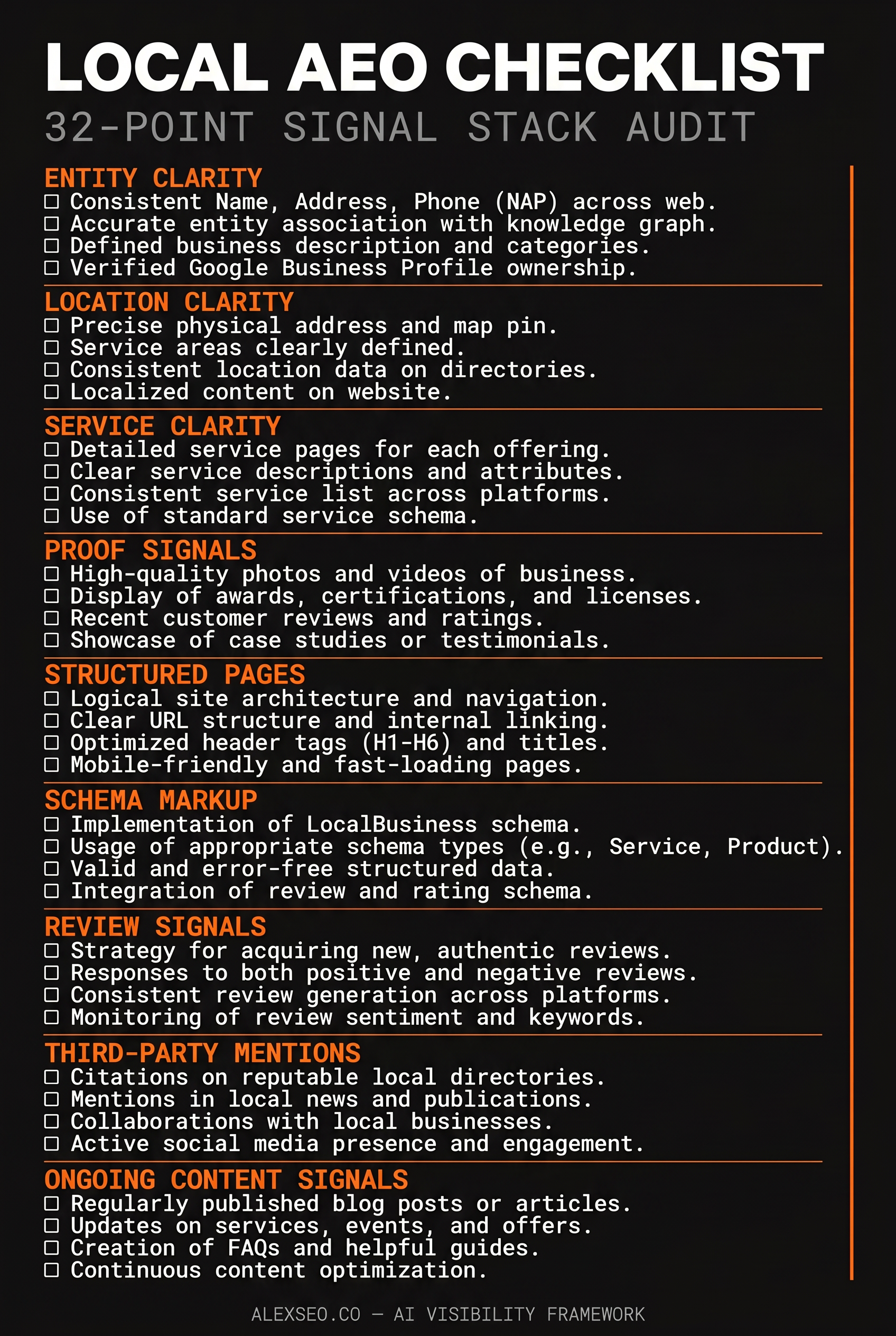
Entity Clarity
- Business name is identical across website, GBP, schema, and all citations
- GBP is claimed, verified, and fully completed
- Primary and secondary GBP categories are specific, not generic
- Business description answers "what does this business do?" in plain language
Location Clarity
- Service area is explicitly defined on website and GBP
- Address or service area is consistent across all sources
- City and location associations are clear in content and schema
Service Clarity
- All services are named and described on the website
- GBP Services section is complete with named services and descriptions
- A dedicated service page exists for each primary service
Proof Signals
- GBP has at least 50 reviews with specific service and location mentions
- Reviews are responded to consistently
- Business is listed on tier-one directories with consistent NAP
Structured Pages
- Service pages open with a direct answer to "what is [service] in [location]?"
- H2/H3 headings are question-based or answer-first
- FAQ block exists on service pages and homepage
Schema Markup
- LocalBusiness JSON-LD is implemented on the homepage
- Service schema is implemented on service pages
- FAQPage schema is implemented on all FAQ blocks
- sameAs links in schema point to GBP, LinkedIn, and other verified profiles
Review Signals
- A review generation process is in place that prompts customers to mention specific services and locations
- Review platform diversity exists — Google plus at least one other platform
Third-Party Mentions
- Business is listed in relevant industry-specific directories
- Business has at least one local news or blog mention
- Owner LinkedIn profile is complete and associated with the business
Ongoing Content Signals
- GBP posts are published at least monthly
- Blog or content section is updated at least quarterly
- New reviews are being generated consistently
When to Request an AI Visibility Audit
If any of the following describe your situation, your business has a structural AI visibility problem that warrants a professional audit.
You rank in Google but do not appear in AI Overviews for your primary services. You have searched for your business in ChatGPT, Perplexity, or Google AI Overviews and gotten vague, incomplete, or incorrect information. Competitors are being cited by AI tools and you are not. You have never audited your entity signals, schema markup, or GBP for AI legibility. You are investing in content and SEO but not seeing AI visibility improvements.
An AI visibility audit diagnoses exactly where your signal stack breaks down and gives you a prioritized fix list — starting with the highest-impact gaps and working through the full Local AI Visibility Stack.
The Window Is Open
Local AEO is not about tricking AI. It is about making your business structurally legible to systems that read, verify, and cite.
The businesses that build this infrastructure now will own their categories in AI search for years. This is the same dynamic that played out with local SEO in 2012–2015. The businesses that built Google Business Profile profiles, earned citations, and structured their sites early dominated local search for a decade. Most of their competitors never caught up.
The window for local AEO is open right now. Most of your local competitors have not started. The structural advantages are available to any business willing to build them — and they compound over time.
The first step is understanding where your signal stack breaks down.
Ready to find out what AI currently knows about your business? Request an AI Visibility Audit →
About the Author
Alex Rodriguez is an AI-first SEO operator based in Cedar Park, TX. 15+ years building content systems that drive AI visibility and organic growth.
About Alex →Want This for Your Site?
I build content systems optimized for AI answer selection. Start with an audit.
Request an Audit